
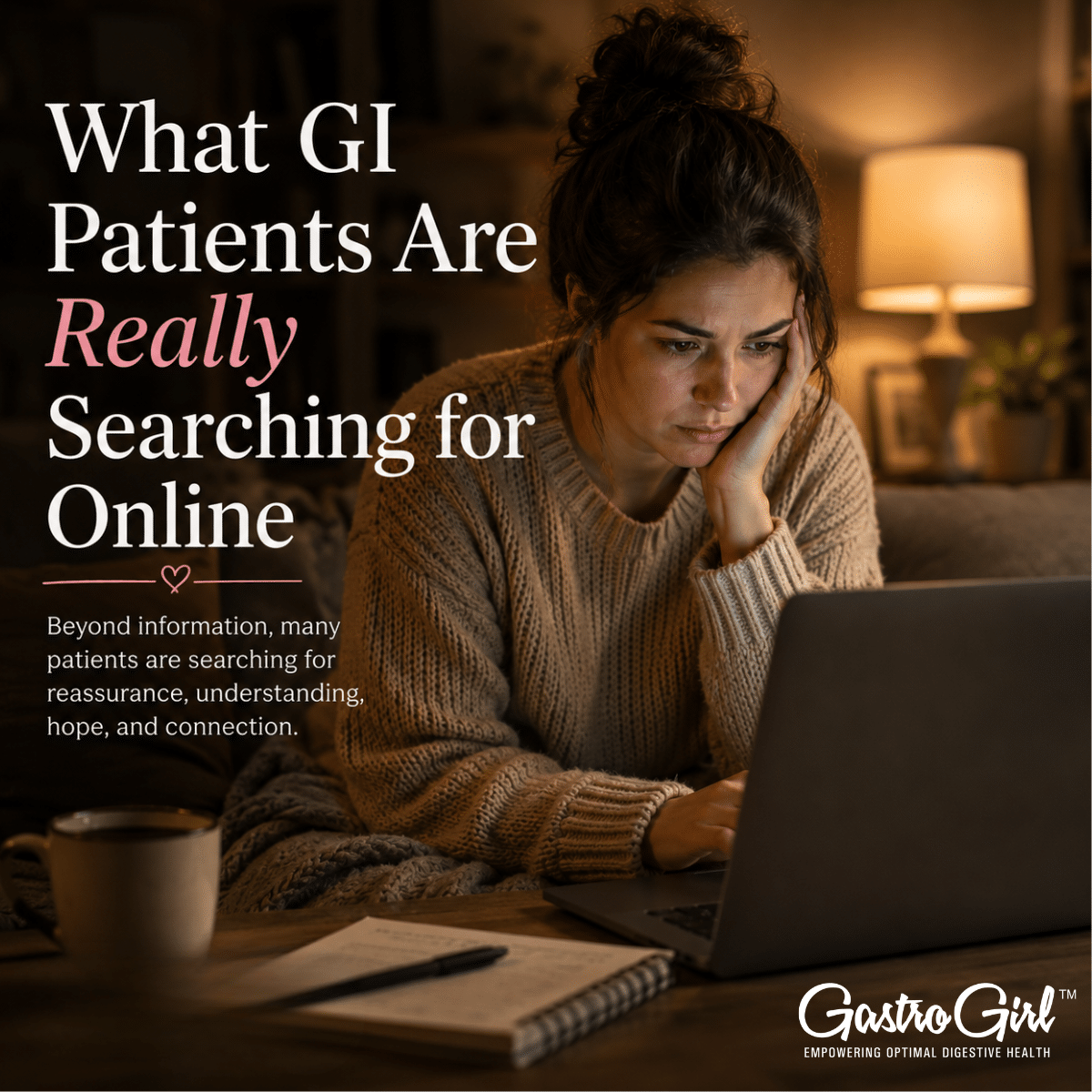

What GI Patients Are Really Searching for Online
By: Jacqueline Gaulin
Digestive suffering is often invisible.
It lives in the quiet moments people rarely talk about — the canceled plans, the anxiety before meals, the exhaustion of constantly thinking about symptoms, the fear of not knowing what is wrong, and the emotional weight of feeling misunderstood.
For many people living with digestive conditions, the struggle extends far beyond the physical symptoms themselves. It can affect confidence, relationships, work, travel, identity, and the simple ability to feel comfortable in your own body.
And when people feel alone, dismissed, embarrassed, or desperate for answers, they begin searching.
Searching for relief.
Searching for reassurance.
Searching for understanding.
Searching for someone who finally says, “I believe you.”
That is why the recent article by Dr. Trisha Pasricha in the latest issue of the American College of Gastroenterology magazine resonated with me so deeply.
In her article, Dr. Pasricha explores GI misinformation, social media, and the growing challenge of helping patients navigate digestive health information online. It resonated with me not only as someone who has spent years in digestive health communication, but also as someone living with IBS who understands firsthand how emotionally and physically exhausting digestive symptoms can become over time.
One of the ideas from Dr. Pasricha’s article that stayed with me most is this: people are not just searching for information online. They are often searching for comfort, reassurance, acknowledgment, validation, and hope.
And honestly? I understand that.
When the Body Starts to Feel Unfamiliar
Digestive symptoms can feel deeply personal and embarrassing. Many people suffer silently with bloating, bowel changes, bowel urgency, abdominal pain, reflux, constipation, diarrhea, trouble swallowing, or food-related symptoms for years before openly discussing them with a healthcare provider.
The search becomes something deeper than symptom relief. After years of struggling, the illness or symptoms can slowly become intertwined with their identity. The exhaustion, fear, restrictions, and uncertainty can begin to shape how they see themselves and how they move through the world.
And for many women navigating perimenopause or menopause, the body can suddenly feel unfamiliar. Hormonal changes can affect far more than the GI tract — influencing digestion, bloating, bowel habits, sleep, anxiety, energy, mood, metabolism, and the way we physically experience our bodies.
For women already managing digestive symptoms, these changes can make it even harder to understand what is driving a particular symptom, where one condition ends and another begins, and whether what they are experiencing is related to hormones, digestion, stress, aging, or something else entirely.
When digestive symptoms begin shifting alongside so many other physical and emotional changes, it can create a deep sense of uncertainty and vulnerability. Many women find themselves searching online, trying to understand what is happening to their bodies and whether what they are experiencing is “normal.”
Sometimes the search for answers is not just about symptom relief. It is about trying to reconnect with a body that no longer feels entirely predictable or understood.
I understand this personally, too. At times, I felt betrayed by my own body — as though I no longer recognized it.
I’ve had moments where the endless searching for answers, explanations, and solutions only left me feeling more anxious, overwhelmed, and desperate for relief. The deeper you search, the more noise you encounter. And when you are already vulnerable, that noise can begin to feel consuming.
Sometimes the search itself becomes part of the exhaustion.
Fortunately, I have also experienced how meaningful it can be to work with healthcare professionals who truly listen, collaborate, and acknowledge the full picture of what patients are experiencing — physically and emotionally.
Feeling heard does not solve everything overnight. But it can ease fear, restore trust, and open the door to more meaningful conversations with healthcare professionals.
Why Patients Turn to Online Spaces
When someone feels scared, dismissed, confused, isolated, or desperate for answers, it makes sense that they would turn to social media, online communities, influencers, podcasts, Reddit threads, TikTok videos, or wellness content looking for guidance.
For many patients, these online spaces can feel like a warm blanket of comfort — a place where they finally feel heard, understood, validated, and less alone in what can often feel like an isolating experience.
And truthfully, I’ve done it too.
Even after years working in digestive health, I’ve had moments where I noticed a new symptom, felt anxious, or felt too embarrassed to immediately bring something up to a doctor — and I searched online looking for answers or reassurance.
I think many of us do this more than we admit.
That doesn’t make us foolish. It makes us human.
The search for relief often happens in the quiet corners of the day, late at night, during moments of fear, exhaustion, or endless doomscrolling through social media and online forums. In those vulnerable moments, seeds of worry can quickly take hold.
Suddenly, every symptom feels catastrophic. Every post sounds familiar. Every video promises an answer.
Before long, many of us find ourselves self-diagnosing, convinced they have multiple conditions, spending hundreds — sometimes even thousands — of dollars on online tests, supplements, restrictive protocols, and wellness products in search of relief, clarity, or certainty.
But this is also where things become complicated.
The Problem With “Gut Health” Online
As Dr. Pasricha noted so well, one of the reasons GI misinformation spreads so easily is because it often contains a kernel of truth. The microbiome is real. The gut-brain connection is real. Nutrition matters. Stress can impact digestion. But online, these concepts are often oversimplified, exaggerated, or transformed into fear-based messaging and promises of miracle solutions.
What makes this even more challenging for patients is that “gut health” has become an enormous industry.
Over the last several years, the wellness market around digestive health has exploded. At times, it can feel like everyone online has become a gut health “expert.” Social media feeds are flooded with influencers, supplements, restrictive diets, detoxes, microbiome tests, powders, protocols, and wellness trends; many marketed with confidence that may exceed what current evidence can fully support.
For patients already struggling, this creates an incredibly confusing landscape to navigate.
When someone is exhausted, scared, uncomfortable, or desperate for relief, it can be incredibly difficult to separate evidence-based guidance from persuasive marketing. Especially when the messaging is wrapped in scientific language, emotional storytelling, beautiful branding, and promises of finally feeling better.
And in many ways, the wellness industry has recognized something healthcare often overlooks: patients are not just searching for treatment. They are searching for hope, belonging, identity, validation, and community.
That emotional connection is powerful.
But it also means patients are increasingly forced to navigate a world where credible information, personal experiences, marketing, pseudoscience, and genuine medical breakthroughs are all blended in the same online spaces.
And when people are vulnerable, suffering, and searching for answers, certainty can feel incredibly comforting — even when the science is incomplete.
What Misinformation Really Reveals
What concerns me most is not simply the spread of misinformation itself, but what the rise of misinformation reveals about modern healthcare communication.
Patients are hungry for connection.
They want someone to explain complex information in a way that feels human. They want acknowledgment that their suffering is real. They want to feel less alone. They want guidance that feels accessible, compassionate, and hopeful.
Too often, medicine communicates in a language patients cannot emotionally connect to, while misinformation speaks directly to fear, identity, and emotion.
That is why misinformation spreads so effectively.
The wellness industry understands storytelling. It understands branding. It understands emotion. It understands community.
Healthcare, on the other hand, often assumes facts alone are enough. But facts without connection rarely build trust.
The Opportunity for Healthcare Communication
I also believe the healthcare system must reflect honestly on why this gap exists.
Many patients have felt dismissed. Many have struggled to get answers. Many have felt embarrassed discussing digestive symptoms. Many have felt overwhelmed trying to navigate conflicting information.
For some, years pass before they receive a diagnosis or feel truly heard. During that time, they are often left alone trying to make sense of symptoms that affect not only their physical health, but also their relationships, confidence, work, travel, food choices, social lives, and emotional well-being.
That frustration creates a void. And when trusted medical voices are not present in the spaces where patients are seeking information, other voices will fill that space.
This is why I believe digestive health communication must evolve.
Patients deserve more than clinical accuracy alone. They deserve communication that is evidence-based and emotionally intelligent. They deserve conversations that acknowledge uncertainty honestly without abandoning science. They deserve healthcare professionals who recognize the emotional burden GI symptoms can carry.
I also think patients have an important role to play.
As patients, we must learn how to think critically about the information we consume online:
- Ask where the information comes from
- Be cautious of “miracle cure” language
- Understand that one person’s experience is not scientific evidence
- Recognize that healing is rarely one-size-fits-all
- Bring questions into conversations with qualified healthcare professionals
At the same time, healthcare professionals, researchers, communicators, journalists, patient advocates, and trusted organizations all have a responsibility to help create a healthier information ecosystem.
One of the most powerful ideas from Dr. Pasricha’s article is that physicians, journalists, and communicators should not operate in silos. We need collaboration between scientific expertise, communication skills, and digital reach if we truly want to combat misinformation at scale.
I believe this is one of the defining healthcare challenges of our time.
Not simply misinformation itself — but the erosion of trust, the emotional isolation patients feel, and the growing gap between where patients seek information and where healthcare systems communicate.
Key Takeaways for Patients
Feeling embarrassed or overwhelmed by digestive symptoms is more common than you may realize.
-
- Searching online for answers does not make you weak or foolish — it makes you human.
- Not all “gut health” information online is evidence-based, even when it sounds scientific.
- Be cautious of fear-based messaging, miracle cures, and one-size-fits-all solutions.
- Your symptoms are real, and you deserve compassionate, evidence-based care.
- Open conversations with trusted healthcare professionals remain essential.
- You deserve both empathy and accurate information.
I believe patients deserve both empathy and evidence. They deserve compassionate care and credible information. They deserve to feel heard without being misled.
Most importantly, no one should feel too embarrassed to talk about digestive symptoms. And no patient should feel like they must navigate their health journey alone.
Behind every search is a person looking for answers. Often, they are also looking for reassurance, understanding, and hope.
Because what many patients are really searching for isn’t just information.
It’s the comfort of knowing they are not alone.


Featured Articles
September 28, 2026
IBS-C: Expert Answers, Patient Perspectives & Resources




Let’s Keep in Touch!
Subscribe to get the latest news and content delivered straight to your inbox.
Listen to our
latest Podcast!